


Photos by Alec Hosterman
Read more at: https://farmvilleherald.com/2026/03/waterworks-presents-alice-by-heart/
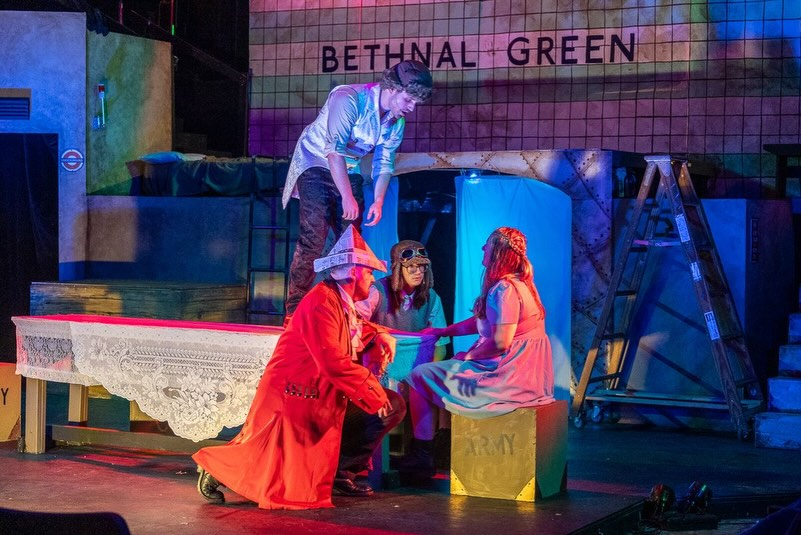
“What’s the point of turning the key if you don’t go through the door,” asks the Cheshire Cat (Maya Hoffman) to Alice Spencer (Kolby Logue). I hope you go through the door of Waterworks Theatre this March and down the (rabbit) hole with the cast of their new musical “Alice by Heart,” a story set in the war-torn bunkers of London that brilliantly matches the chaotic, creative space of “Alice in Wonderland” with the psychological trauma and claustrophobia of World War II. This is all brought off the page with music by 1990s rock star Duncan Sheik, lyrics by Steven Sater, and a book by Steven Sater and Jessie Nelson that captures the heartbreaking tale. As lead Kolby Logue said, “Alice by Heart” “makes you laugh, breaks your heart, and leaves ou with hope.”
COMING OF AGE
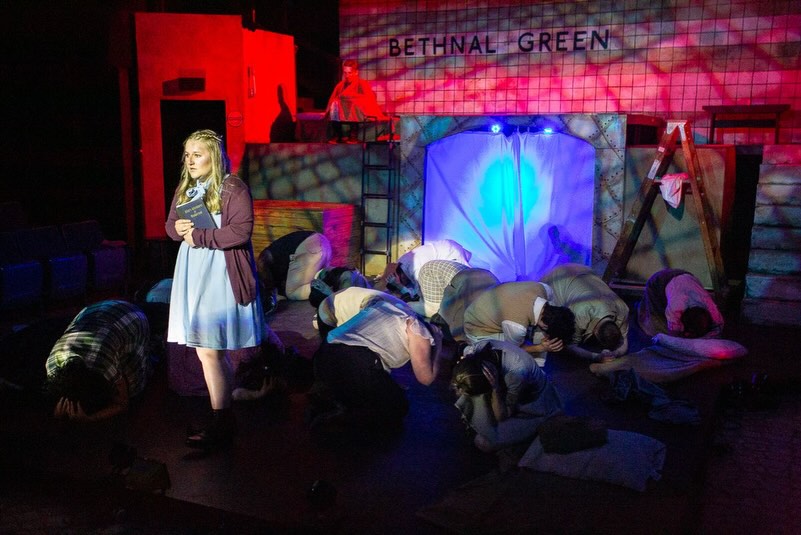
We open on a blue silhouette of Alice and her book. After emerging from behind the curtain, the chilling “West of Words” opens the show right before the air raid sirens blare and bring the rest of the cast tumbling to the stage in the immediacy indicative of those moments. While this may officially start the musical, the show really starts as soon as you enter the theatre to find your seat. March’s fickle weather dropped from beautiful and sunny to drab and cold the day I visited, forcing the Waterworks space to completely feel like the barren drabness of an underground bunker. The pre-show music felt like a 1940s radio station with hidden sounds of bombs between songs.
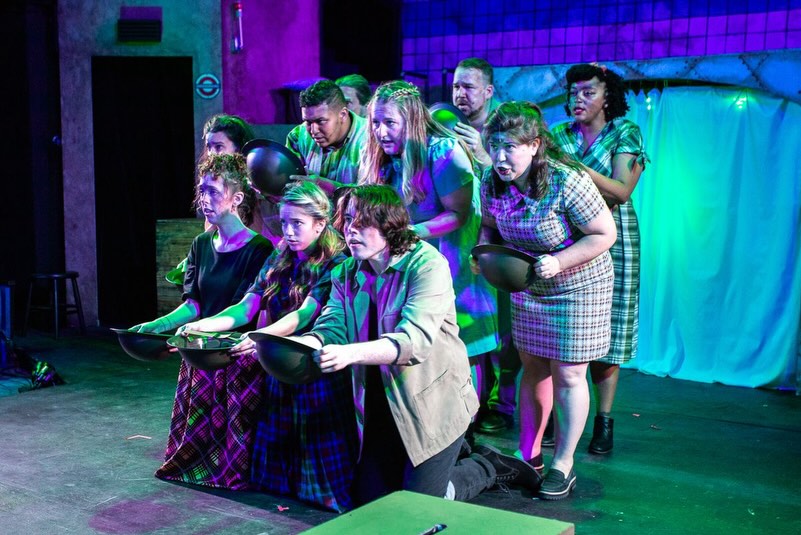
With signs on the wall and the lit stage fully open to greet you, you are transported to that bunker yourself. The audience is taken directly into the world with Alice and her cast, setting up the primary story: one young woman’s desperation as her friend is dying of tuberculosis in that London Blitz bunker. Logue said Alice is “desperately clinging to the one thing that has always made her world make sense, and watching that slip away is at the heart of everything she does.” As we follow Alice’s journey through the Kübler-Ross five stages of grief, we come in and out of her reality with her. Into a Wonderland she remembers and manipulates to keep her friend alive. Skipping a large part of the source material, Alice takes us right into denial with the oozing sexuality and glowing hookah pipe with the Caterpillars (Michael Harris and Christen Brunstetter) with one of my favorite songs from the soundtrack, “Chillin the Regrets.” From there, we watch Alice work through anger with the Mad Hatter (Reeves La Roche), bargaining with the Cheshire Cat, Duchess (Jaysinky Barbot), and Jabberwock (Jordan Whiley), and depression with a sea of mock turtles (La Roche, Sarah Reynolds, Jaysinky Barbot, and Kristen Boyle).
But instead of moving to acceptance, we return to bargaining again with the Queen of Hearts (Mary Tackett) in a dramatistic pentad that feels more natural to the reality of the grieving process. That it’s not linear the way Kübler-Ross would have us imagine but rather that we bob and weave through the pages of grief. While we couldn’t have an “Alice in Wonderland” story without the iconic Queen of Hearts character, the way this musical understands its human motivation, its agents, its purpose, is why this penultimate trial scene (both campy and dramatic) helps Alice reach acceptance and find her agency.
This is absolutely where Kolby Logue captures the Alice character. In this singular moment, when she’s ready for the “off with her head” moment. Literally on the chopping block.
And she smiles.
Not a smile of fun like the audience has just had with the amazing comedic timing of that scene, but because this is her agency. Her knowing that she controls the narrative. That the Alice of her imaginary Wonderland is able to return to reality from her loneliness and realize she’s “shrunk enough.”
To get into her role as Alice, Logue said, “I had to sit with each stage of that journey and ask myself, what does it feel like to bargain with loss through imagination? Once I found that, Alice stopped being a character I was playing and started being someone I was living.” The King of Diamonds (Jordan Whiley) declares, “We are here and sometimes we let you in our dreams.” But instead, Alice accepts that she is in control of her grief. It’s a tale of hard-learned maturity at an early age and how war is a human story that forces those lessons.
SETTING AS LEAD CHARACTER
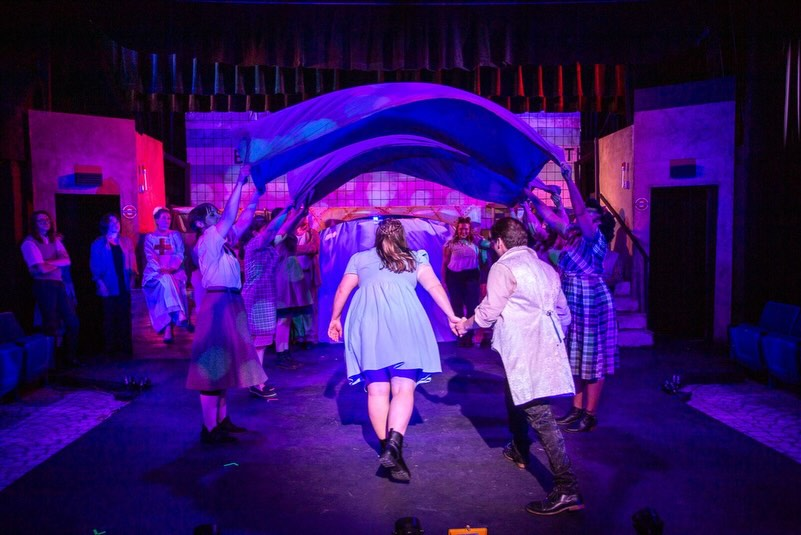
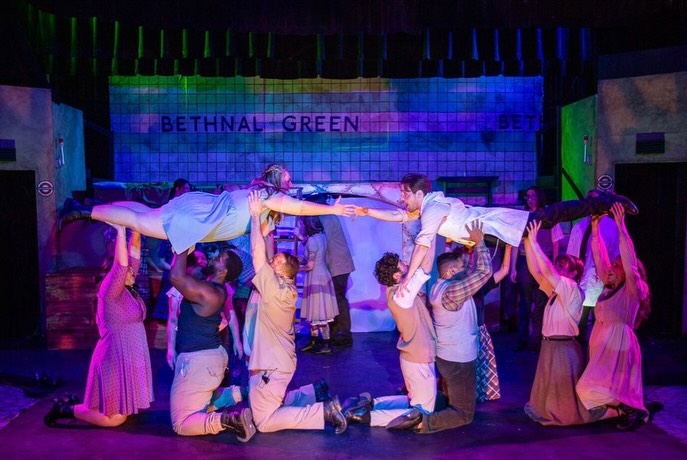
If you love amazing storytelling, you need to go see this show. But more than that, you need to see it here at Waterworks. While community theatres are sometimes limited with resources and space, the intimacy of the theatre lends itself perfectly to a tight, cluttered stage – making it feel like you’re in the bunker with the cast. That you’re part of the story, too. That when Alice goes “down the hole” and returns in those moments when war pulls her out of her Wonderland, you’re right there with her. And this was done purposefully and thoughtfully.
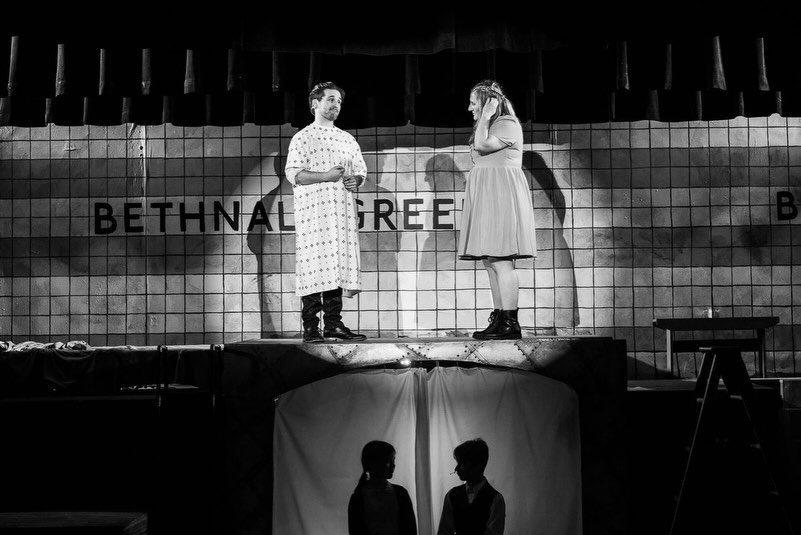
Director Elijah Logue “wanted the audience to feel like they were there with them.” From the tall walls so that we would feel like we were underground, to the Air Raid Shelter signs along the walls as you enter to find your seat, to the choice of using Bethnal Green station as their setting. Logue had done his research, and it was clear. So much so that audience member Jes Simmons took note.
“My mom was in London. She’d say they would come out of the underground not knowing what would be there,” Simmons said. “They’d hear the percussive booms and feel them. If the sirens came on, they went down immediately.” This is captured perfectly with the stomping of the stage sounding like bombs through to the detailed choreography, sirens filling the air, and the cast running in along the seats instead of from backstage. Logue’s vision came long before he came on as director, though.
“About two years ago, I fell in love with the music and continued to fall in love,” he said. “I felt it would go well in this space, and I knew eventually I wanted to do it here.”
For the first time, Logue brought his vision for “Alice by Heart” to the Waterworks Players annual season reveal event, showcasing a number from the musical that had only been rehearsed a few times with his friends, who he would eventually cast in his vision for the show. A veteran director and player himself, Logue is familiar with what the space can do.
FINDING ALICE AND HER CAST
Logue was right that Waterworks was the place for this show, and the community saw it, too. “Alice by Heart” piqued a lot of interest. When it came to casting back in late fall, Logue said they had close to 50 people audition amongst the two days and self-tapes, which is the most he’s seen there at Waterworks. With 19 roles plus an ensemble to cast, he had a great talent pool ready to fill that stage for him.
The show even had a bevy of outside talent interested and said his cast had three people from North Carolina, one from Williamsburg, and one who grew up in the Lynchburg area who came back from a contract in Tennessee just to play the lead in this show. Logue said, “There’s not a lot of young male talent in the area so I needed to recruit.”
Stage Manager LeeAnn Schock said they began rehearsals in January and started adding choreography in February.
“People came in day one knowing their harmonies and parts,” Logue said. So they were ahead of what he had scheduled, giving them more time to get down to blocking and choreography. “I have a great team of people, so I don’t feel like I’ve done as much as I need to do.”
The wholeness of the cast is what makes this show really shine. They fill that stage to capacity, fully understanding the stage itself is a character. And so does Kolby Logue, who is serving double duty as both Alice and choreographer.
“Kolby put her heart and soul into the choreo,” said Director Logue. “It’s nothing I’ve seen us do on this stage before.” With 15 musical numbers, this is quite the choreographer’s task, but Kolby Logue has it down. The hand movements, the props, the stage, and the dancing are cleanly choreographed and had several audience members raving afterwards. Myself included. The story and music are good, but to sell the story, the choreography needs to be tight.
And Kolby Logue (and Skkyler Travis for that one move) knows her character and knows her show in what she calls “the unraveling of Alice’s world.”
“As each number passes, you’ll notice movements beginning to reappear – steps and phrases recycled and reimagined — because Alice herself is starting to jumble the stories together, losing her grip on the Wonderland she has so carefully constructed,” said Kolby Logue.
The quiet, subdued connection between Logue’s Alice and Travis’s Alfred/White Rabbit are seen through their movements; their closeness drifting in and away from one another on that stage and showing the movement through grief and the inevitability of death.
“I wanted the dancing to mirror her unraveling in real time, so that even before a word is spoken, the body is telling the truth,” said Kolby. “Every dance had to serve the story, not just the music, because in this show, movement is grief made visible.”
Within the cast, there were other star performances to take note of here.
“I don’t think I have the words to fully describe how talented these humans are. Getting to watch them show up every day and pour themselves into these characters has been such a gift,” said Kolby.
Jordan Whiley’s Jabberwock was the perfect combination of scary and claustrophobic, reminding me of a cross between “Phantom of the Opera” and those stalker and clicker cordyceps monsters from “The Last of Us.” The cast falls off the stage in zombielike movements, dressed in hospital gowns and physically surrounding Alice and the Jabberwock. This captures that claustrophobia of both the bunker and the part of bargaining in grief that comes with just desperately needing to get out of the fear but being consumed by it. The Jabberwock represents the reality of fear; the anxiety that comes from a terminal diagnosis, which is why Alice imagines the bunker doctor who has diagnosed Alfred as this nightmare creature. Whiley’s lithe creeping across the stage, heavy wheezes, and dramatic baritone embody this fear and prepare us for act two.
Jaysinky Barbot’s Duchess stole the stage a few times. Even the quiet side eye he gave during the trial scene in act two was everything within his full body and face performance. He didn’t have to be saying anything for you to know who he was; he had given in completely to the intentional campy diva of his character, and it paid off.
Mary Tackett as the iconic Queen of Hearts delivered a strong, high vocal belt coupled with amazing commandment of the stage and comedic timing. Her playfulness with the other cast members, including a diva-off with the Queen of Diamonds (Sarah Wheeler), brought this character to life in a way that made it possible for the audience to follow along with Alice’s movement into acceptance. True to the story, Alice needs to go through the Queen of Hearts to reach the end, and Mary Tackett is making her work for it in the most delicious way.
Besides the emotional turmoil of Alice, Reeves La Roche has what I think is the hardest part in the play. He has to go from capturing the pure madness of the Mad Hatter to the dramatic sadness of the Mock Turtle to the traumatized soldier in the bunker. While all cast members are pulling multiple roles (as the play intends), La Roche differentiates between these three characters in a way that lets you understand the personification of post-traumatic stress disorder (PTSD) his specific combined roles required.


Leave a Reply